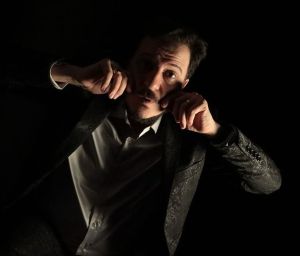
![[NEW] Mehmet Ali Sanlıkol (2026)](images/exclusive/interviews/INT-MemAliSan2-3.jpg) [NEW] Mehmet Ali Sanlıkol (2026)
[NEW] Mehmet Ali Sanlıkol (2026)
Let’s Talk About the Turkish Blues
For those not in the know, Turkish-American composer, multi-instrumentalist, and New England Conservatory full-time faculty member Mehmet Ali Sanlıkol has just released his brand new recording titled THE ELECTRIC OUD MAN SPEAKS and you listen..., a five-track project centered on his custom semi-hollow electric oud — an instrument he first envisioned more than 20 years ago and only recently had the means to realize.
The album features a close, long-standing working group: Mark Tipton (trumpet, flugelhorn), Edmar Colón (saxophone), James Heazlewood-Dale (bass), and George Lernis (drums).
The project originates in a problem Sanlıkol encountered early: the acoustic oud could not properly function inside a modern jazz rhythm section. In his initial attempts, it fed back, disappeared in volume, and collapsed the moment the drums asserted themselves.
If the oud was to hold its own in a contemporary ensemble, it needed a transformation similar to what the guitar underwent in the early 20th century — magnetic pickups, steel strings, and a redesigned body capable of handling volume and dynamic range.
Working with an American guitarist and oud enthusiast, Mac Ritchey, Sanlıkol developed a semi-hollow electric oud that travels well, stays in tune, and can withstand the physicality of a jazz-fusion band.
I sat down with Mehmet and we discussed everything from this new album, how the oud came into being in his life, and amongst other things, he also reveals a little something that made such a big impression on him; and that he has never spoken about in any other interviews to date!
Please tell us more about this new recording that is centered on your custom semi-hollow electric oud, as it is told that it is an instrument you first envisioned more than 20 years ago but only recently had the means to realize. Does that mean an oud such as this never existed in real life outside of your mind and you had to give someone your cultivated specifics to have one built just for you and you alone? - “Yes, absolutely! Let me be more specific: until very recently, if you Googled “electric oud,” what came up were instruments with nylon strings and piezo pickups. I’m sorry to say, but I found the sound of those instruments quite repulsive.”
“And when I started experimenting with the traditional acoustic oud in jazz settings more than 20 years ago, I kept running into a major problem: the acoustic oud simply could not compete with a modern rhythm section — unless the drummer played with brushes and the overall dynamic remained constantly soft. It would feed back, disappear as soon as the drums started playing loud.”
“So I kept thinking about what happened to the guitar. The guitar went through an extraordinary transformation, eventually involving steel strings and magnetic pickups, different kinds of bodies, etc. So I kept asking myself: why couldn’t something similar happen to the oud?”
“The person who finally made that possible was my good friend Mac Ritchey, who is a sound engineer and guitarist who also plays the oud. What I didn’t know was that Mac was also a luthier! Once I found that out and saw and heard some of the instruments he had built, I was convinced that he was THE man for the job,” he smiles.
“What Mac built for me is a semi-hollow instrument with a slightly smaller pear-shaped body, steel strings and magnetic pickups -- I always wanted a semi-hollow body instrument because I wanted to preserve at least some of the acoustic properties of the traditional oud. It is unmistakably an oud as it is still fretless, has 11 strings, and is tuned like an oud, but it can enter a completely different sonic world.”
“I should add that shortly after I started releasing videos featuring my electric oud, a Turkish company came out with a fretless instrument with steel strings and magnetic pickups that they are calling an electric oud. BUT I’m afraid their instrument has only six strings, like a guitar. And, if I’m not mistaken, Mac has recently started receiving commissions to build a few more electric ouds as well. I believe those are solid-body instruments, though.”
And with a lot of instruments that are custom made, melded as one thereafter with the musician to whom it was made for, said musicians tend to give names to their instruments. So, have you given yours a pet name, perhaps? - “I am afraid I haven’t. I suppose I’ve always simply called it “my electric oud”, but considering how much this instrument has changed my musical life in only a couple of years, perhaps it deserves a name by now. That said, maybe I haven’t given this much thought because I have another instrument that I created and named, which is still in its development stage. That instrument is called the SANLIKOL Renaissance 17 (Patent 12,334,044) and it is a digital microtonal keyboard with 17 keys per octave. Since that instrument is not directly related to this interview, I don’t want to diverge and talk about it at great length, but information, images and videos of the instrument can be found on my website.”
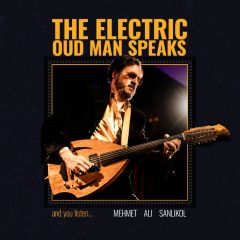
In our review, we tell everyone that the album is a blend of tracks that are “Turkishly-melodic, bluegrass-imbibed, low slung blues-fueled ... atmospherically-charged ... melodiously guitar-driven, blues-hued ...” and amongst others, “emotively chorded balladry” and even “funkalicious,” but how would you yourself describe this quite superb five-track album? - “Well, first of all, thank you SO much. And I must say that I love your list! When I first started promoting the album, I came up with a somewhat humorous one-liner: “Imagine Stevie Ray Vaughan and electric Miles Davis meeting at a Turkish coffeehouse!” he smiles. “And, frankly, I still think that that image captures something essential about the record.”
“By now I have lived with Miles, Bird, Stevie, Jimi, Herbie, many Turkish masters, and more for 40+ years - I’m not counting the classical masters here, since their art has a more indirect impact on this particular album. I have internalized Turkish music and the makam tradition, jazz, blues, funk and rock, so I don’t really think of what I’m doing as “fusion.” After so many years, all of these musical languages coexist naturally within me.”
“So, in some ways, this album is the documentation of my discovering this instrument and, through the instrument, discovering another side of myself as a musician and composer.”
And was the title always going to be The Electric Oud Man Speaks and you listen ...? And just where did that originate? - “No, the title didn’t exist from the very beginning. The music really came first, and the identity of the project became clearer to me as I kept playing the instrument and writing for it.”
“At some point I realized that this wasn’t simply going to be another jazz record featuring an electric oud. In fact, I started developing a kind of slick character with the shades. So, “The Electric Oud Man” almost became a character or an alter ego. And that’s where the title came from.
And I liked the slightly ridiculous confidence of “...and you listen”. There is definitely humor in it, but I’m obviously not ordering anybody to listen! That said, I had been imagining this instrument for more than 20 years. So when the Electric Oud Man finally had something to say, I suppose I thought: OK, now you listen,” he again smiles.
Going back to the oud for a moment, having dreamt about this certain one, the way you would play it, hold it, master it for all those years, did it all come naturally for you when the custom oud was placed before you - or were there some learning curves, so to speak? - “This was actually one of the biggest surprises, as the second I held it in my hands, it felt completely natural. Obviously, since it’s tuned like an oud, it should feel natural. But that’s not what I’m talking about. I mean, the style that emerged out of me -- makam meets rock meets jazz -- just somehow came gushing out of me.”
“And, of course, there was still a learning curve. The steel strings react differently, the smaller semi-hollow body feels different, and amplification, distortion, sustain and effects open up possibilities that simply don’t exist in the same way on the traditional acoustic oud. But the important thing is that I never felt as though I was struggling with the instrument. In fact, quite the opposite: It felt like it allowed me to speak in a way that I wasn’t able to on the acoustic oud, or any other instrument.”
And now given your expertise on the oud, in reflection, which of the tracks on this new release can you now sit back and listen to and nod to yourself that what you just heard, and for whatever reason, is your own personal favorite of the five? - “I’m afraid I really cannot pick one because they are all so different from each other, as a result of which they represent very different approaches to the electric oud. “Pickin’ A Shuffle Alla Turca” is the high-energy show opener where I incorporate bluegrass-like fingerpicking. “Another Dream in Nihavend” is all about reflection, and while the makam qualities are unmistakable, I still put the distortion on and rip it.”
“Well, it all started with “Talk About A Turkish Blues,” which is both makam-heavy and the real deal slow 6/8 blues. “A Poignant Truth,” the solo oud track, allowed me to stretch the boundaries of what I could do with arpeggios on a fretless instrument. And yet with “No Big Deal,” I ended up going into full-on Herbie Hancock & The Headhunters mode and channeled Stevie Ray Vaughan when soloing.”
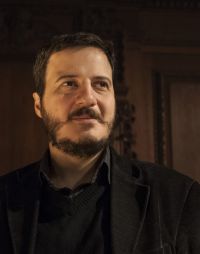
You were raised in Istanbul by a classical pianist mother, musically surrounded by Beethoven, Mozart and Chopin, so at what point did your young brain turn away from classical and find its interests more attune to that of the jazz world? - “Actually, I should make one small correction: I was raised in Bursa, not Istanbul. That said, I had lots of family in Istanbul and, since Istanbul and Bursa are about as close to each other as New York and Boston, we visited them pretty much every weekend. So Istanbul was very much a part of my childhood as well.”
“My mother is a classical piano teacher, so I grew up listening to Beethoven, Mozart, Chopin and many other classical masters. But it all changed when I was introduced to progressive rock music at age 13. I distinctly remember an older friend playing Ritchie Blackmore’s Rainbow and me being very impressed by the classical influences in that band’s music.”
“Suddenly I heard a kind of music that was both wild and had classical music influences in it. However, I was in search of more sophisticated expressions too. So, within 2-3 years I discovered jazz masters like Charlie Parker, Miles Davis, Herbie Hancock, Chick Corea and many others. Then jazz became a huge part of my musical identity. In fact, jazz is what eventually brought me from Turkey to Boston.”
“By the way, I don’t think any of these musical worlds replaced one another. Classical music, jazz, Turkish music, rock. I devoted many decades to them, as a result of which I was able to internalize them all.”
You have citied that you still have a love for rock bands such as Deep Purple, Led Zepplin, Pink Floyd and even the great Jimi Hendrix, so can you reveal if there are any of their riff influences to be found within any of these five new songs, perhaps? - “Absolutely! Look no further than “Pickin’ A Shuffle Alla Turca”. That said, I don’t necessarily mean that the riff that opens this piece is like this Zeppelin song or that Hendrix lick. It may certainly be similar to something — that’s just how music works — but not consciously. What I can say for a fact is that the energy and the attitude of that piece is heavily influenced by those bands and artists.”
“In fact, I keep imagining in my head that one day I get to open a concert at some really crowded outdoor summer festival with that song channeling the kind of energy Stevie Ray Vaughan would’ve projected when opening a set at a similar venue.”
What would you most like for those that listen to your new album to get from their listening experience? - “At first listening, the music may come across as “simple” — I guess it could also be called “accessible” for that reason, and there’s nothing wrong with that! But the way I was able to have the segah makam, shuffle feel, fingerpicking and a driving rock riff come together in a way where the listener cannot necessarily hear them separately is what I would hope people get to notice. And I must add that all of the tracks have this particular quality embedded in them.”
“But this is a difficult ask from the listener simply because what I’m providing sounds natural and coherent. So, the listener is less likely to notice all of these different elements coming together. In fact, listeners are more likely to notice and applaud those projects where such elements come together in a piecemeal fashion! Sad, but true. And this is the nature of life, art, music, etc. So I am trying not to be bitter about it.”
“Because it does hurt an artist to see some musician simply put together really good musicians in their own genres within a band/an ensemble, put some music in front of them, plan a few transitions and create a program which then becomes the next big sensation. Mostly, this is due to audiences seeing these disparate cultural/musical elements on the same stage — in other words, a simple juxtaposition of musical traditions rather than a truly coherent musical statement. The separate nature of it all provides the illusion of “Wow! Look at all of these musicians from all around the world being able to play together so well.” Sure! But there really is nothing musically “amazing” about that,” he smiles again.
“Place two smart and gifted musicians from two very different traditions next to each other and they’ll find a way to make music together. Will what they produce be a musically coherent statement? Most likely, no. Will it be a good ‘show’ for festival audiences around the world? Most likely, yes.
There could always be exceptions, BUT as far as I’m concerned, the overwhelming majority of what’s out there within “world music-influenced” jazz or rock or classical or whatever falls under the mediocre category. Too strong? Maybe. But I know what it takes for a human being to fully internalize a spoken language: years. The same is true for musical languages too. There just is no way around that. So, ask yourself: how many artists really do that? Again, there have been and there will always be exceptions, but that doesn’t change what I just stated.”
“In the end, this short little album IS a coherent statement, but it requires deeper listening to truly hear it, and I very much hope that that deep listening and eventual appreciation of it comes along.”
In closing, and as we are not called Exclusive Magazine for nothing, and so a little exclusive tidbit would be rather lovely to go to print with, can you please tell us something about the making of these songs, of this album, that you haven’t spoken about within any other interviews (and still won’t, outside of this one), thank you - “Well, shortly after I released “Talk About A Turkish Blues” as a single and premiered its video on YouTube, a fan posted a super cool comment where they wrote something along the lines of, “I didn’t know that an Uşşak Blues was possible.” Uşşak is the name of the makam which dominates that piece, and “Uşşak Blues” is exactly how pieces are entitled in the classical Ottoman/Turkish tradition: an Uşşak Peşrev (prelude), for example, would state the name of the makam and the form, kind of similar to saying “C Major Sonata”.”
“Once I saw that comment, it made an impression on me, and some months later, when I finished writing what was to become “Pickin’ A Shuffle Alla Turca,” I decided to temporarily call it “Segah Shuffle,” which was — and still is — the title on the sheet music! In fact, the other day we were rehearsing for an upcoming show when the trumpeter turned to me and asked, “Just to make sure: Segah Shuffle is Pickin’ A Shuffle Alla Turca, right?”,” he broadly smiles, one last time.
And finally, we asked Mehmet to kindly provide a never-before-seen photograph of himself. One that perfectly personified his readiness, his excitement, his anticipation for the world to hear his new musical endeavor. And kindly, this is what he sent.