Eiichi Kudo’s Samurai Revolution Trilogy
(Chiezô Kataoka, Isao Natsuyagi, Junko Fuji, Kei Satô, et al / 3-Disc Blu-ray / R / 2026 / Arrow Films)
Overview: Throughout Japanese cinema, the image of the noble samurai righting wrongs katana in hand remains a fixture of the jidaigeki genre, with the authoritarianism and corruption of the country’s medieval past often attenuated for the sake of spectacle and entertainment. But in the 1960s, director Eiichi Kudo’s Samurai Revolution trilogy shattered this idealized conception of the samurai, providing an authentic and scathing portrayal of Japan’s tyrannical past to question the social and political landscape of his day.
Beginning in 1963 with 13 Assassins (remade in 2010 by Takashi Miike), followed by The Great Killing in 1964 and 11 Samurai in 1967, the Samurai Revolution trilogy depicts the rot at the heart of the Tokugawa shogunate: despotic lords oppress their people and abuse their power with impunity, loyalty to the Shogun is valued above compassion and righteousness, and samurai have shed any trace of nobility in favor of their own self-interest, which they pursue with gleeful cruelty.
Each film portrays a group of honorable samurai driven to plan the political assassination of a corrupt lord, hoping to light the fuse that will eventually destroy the regime. But the rebels must understand the fatal consequences of their mission. Should the Shogun falter, then their lives and the entire samurai class will be forfeit.
Eiichi Kudo masterfully deploys expressive black and white cinematography, spectacular swordfights and compelling performances to paint a rich visual and narrative tapestry, using each film to further explore questions of ethics and morality. Featuring a who’s who of iconic jidaigeki actors including Chiezo Kataoka (Bloody Spear at Mount Fuji), Ko Nishimura (Lady Snowblood), Kei Sato (Hara-Kiri) and Toru Abe (Zatoichi and the One-Armed Swordsman), Kudo’s Samurai Revolution trilogy rank among the most important samurai films ever made and are a must-have for chanbara connoisseurs.
Blu-ray Verdict: First up is 13 Assassins (1963) we get the open story of a group of samurai who plan to assassinate a sadistic feudal lord. Often overlooked abroad, 13 Assassins is clearly on the same level of excellence as Masaki Kobayashi’s Seppuku or Hiroshi Inagaki’s Chushingura/Loyal 47 Ronin of the year before.
For, to my mind, it shares the revolutionary spirit and critical sensibility of Hideo Gosha, Kihachi Okamoto and Kenji Misumi. And the climactic village death trap might even be interestingly contrasted to the finale of Seven Samurai.
This sentiment is even voiced more explicitly by the assassin’s leader, played by Chiezo Kataoka during his final duel with the villain’s otherwise noble chamberlain, Ryuhei Uchida. They are not killing one another out of personal malice, but necessity, and it is the anti-climactic fashion of Kataoka’s end that defies the cliché of genre expectations.
So too does the subsequent death of his loyal vassal, played by Ko Nishimura. The dying Kataoka tells his men to call a halt to the now even more senseless killing, as their historic objective has been reached. However, word does not reach the desperate and unarmed Nishimura in time. Instead of the noble death we might expect for a character of his type, he is brutally killed after a series of dodges and attempts to escape.
Much of the dialogue throughout makes a point of how many koku of land/rice each main character’s title encompasses. This serves to drive home the point of human life’s precise monetary value, even more so does the film’s final shot.
Up next is The Great Killing (1964) where a Shogunate Elder connives to rule Japan by making his puppet, the Shogun’s brother Tsunashige, the next Shogun. The best strategist in Japan, Yamaga, leads a plot to stop the Elder, but his cabal is betrayed and most of the conspirators are captured and tortured.
In the spirit of the anti-establishment sentiment that was prevalent in the jidai-geki of the early 60’s, The Great Killing revolves around a group of revolutionaries who hatch a plot to ambush and assassinate a chancellor in an attempt to keep a corrupt, power-hungry minister from taking control of the Shogunate.
The austere, very disciplined style is enhanced by beautiful black and white cinematography, sparse use of music and a pacing that doesn’t rush to its final conclusion but takes time to examine and shed light on the characters. Kudo might be little known to the west, but certain scenes in The Great Killing reveal him to be an extremely skillful craftsman.
All in all, the film is a solid jidai-geki that combines politics, drama and an action-packed finale but doesn’t quite rise to the cream of the crop.
Lastly, and rounding things off nicely, we get 11 Samurai (1967) where the lord of the Oshi fief is killed by his trespassing neighbor, Nariatsu. But when the Oshi clan is blamed for the incident, eleven of their best warriors decide to trade their lives for justice.
The film features several intriguing plot twists as well as provide authentic glimpses into both the Samurai ethos and, interestingly, its interplay with hostile political forces which two decades later (following the story’s own periodization) would spell the end of the Tokugawa Shogunate and the beginning of the Meiji Restoration (as seen, namely, through one antifeudal and inventively modern character who joins the protagonists in their quest).
And thus what makes up for the predictable plot and under-developed drama that unfolds for us for the majority of the film, is the final battle; one where this is some very good DP work, rain and mud adding to the feeling and some decent swordsmanship going on; so yes, the film ends on a high note. And if you have seen any of the previous two in Kudo’s trilogy you should know exactly what to expect. Nothing groundbreaking, for sure, but a solid, entertaining hour and a half to be had for chambara afficionados, most definitely.
Limited Edition Bonus Content:
High-Definition Blu-ray (1080p) presentation of all three films
Original lossless Japanese mono audio on all three films
Optional newly translated English subtitles for all three films
Limited edition packaging with reversible sleeves featuring original and newly commissioned artwork by Tom Fournier
Illustrated collectors’ booklet featuring new writing on the films by Chris D., Earl Jackson and Alain Silver
DISC ONE: 13 ASSASSINS
Brand new audio commentary by film critic and Japanese cinema expert Tom Mes
The Samurai Variations, a brand new video essay by music supervisor and Japanese cinema expert James Balmont on legendary composer Akira Ifukube’s score for the film
Samurai Guerilla Part 1, an archival interview where Eiichi Kudo’s former assistant director Misao Arai and filmmaker Dirty Kudo discuss Eiichi Kudo and Toei’s role in the Japanese film landscape of the 1960s
Theatrical trailers
DISC TWO: THE GREAT KILLING
Brand new audio commentary by film critic David West
Magician of Light and Shadow, a brand new video essay by film critic and Japanese cinema expert Daisuke Miyao on the cinematography seen in the film
Samurai Guerilla Part 2, an archival interview where Misao Arai and Dirty Kudo discuss the jidaigeki genre and expand on the political dimension of The Great Killing
Masaaki Ito Remembers Eiichi Kudo, a tribute to the director by his former assistant and brother-in-law
DISC THREE: 11 SAMURAI
Brand new audio commentary by film critic David West
Fighting the Poison, a brand new video essay by film critic and Japanese cinema expert Jonathan Clements on the historical setting and context of the film
Samurai Guerilla Part 3, an archival interview where Misao Arai and Dirty Kudo discuss some of the filming techniques seen in the film and the conception of the Samurai as seen in Eiichi Kudo’s jidaigeki films
Eiichi Kudo: The Art of Realism, an archival interview with Fabrice Arduini, filmmaker and programmer for the House of Culture of Japan in Paris, where he discusses jidaigeki and the films of Eiichi Kudo
Official Purchase Link
www.arrowvideo.com
www.MVDshop.com











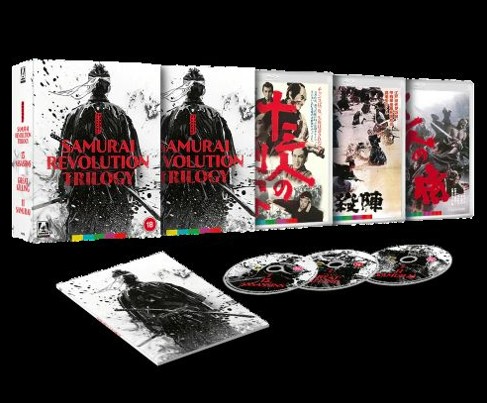 Eiichi Kudo’s Samurai Revolution Trilogy