Title - Comedy & Controversy: Original Albums [1958-61]
Artist - Lenny Bruce
For those unaware, Lenny Bruce was a stand-up comedian, satirist and social observer who was one of the first really controversial figures of stand-up comedy, adopting an unstructured free-wheeling approach that addressed topics no-one else would go near, and not afraid to employ shock tactics in his language and reference points, which eventually saw him convicted of obscenity, although he was pardoned posthumously. One critic said he was “a comic right out of the jazz world ... colossally irreverent .... ribald ... even sometimes rough”.
This 35-track album comprises most of the contents first four albums of his for the Fantasy label - Interviews Of Our Times, The Sick Humor Of Lenny Bruce, I Am Not A Nut, Elect Me! (Togetherness) and American - unfortunately, there was not room for his 19-minute performance The Palladium. The contents of the albums range across a spectrum of topics, satirizing the hypocrisy and pretense of American life, religion, showbiz, political and national affairs, and more - the targets for his barbed commentary know no boundaries.
The year after American was released he was arrested on stage, and by 1966 he was dead from a drug overdose at the age of 50. He broke new ground in comedy and counterculture and this album captures him in the core era of his career and is a startling showcase for one of the boldest and most challenging comedians of all time.
Raise a glass to Lenny Bruce, champion for—and martyr to—Americans’ First Amendment right to free speech. On August 3rd, 1966 — a beautiful summer’s day - the legendary comedian Lenny Bruce died of a drug overdose at age 40 in his Los Angeles home.
The poster boy for what was called “sick comedy” in the late 1950s and early ‘60s was stigmatized, and prosecuted, for performing material about sex that’s tamer than what we can now see on a typical episode of Broad City. But what made the authorities especially eager to tape his mouth shut was Bruce’s vigorous social and religious satire.
The unpredictability that made Bruce an exciting performer—he “cooked” like a jazz musician—made the forces of the establishment, in show business and beyond, nervous. As the 1960s progressed, Bruce racked up arrests for onstage obscenity and drug possession. Consequently, he added to his repertoire of bits a lively reportage of his clashes with the justice system.
This portion of his set grew until, in the minds of some alienated fans, the lectures on the law pushed out the comedy altogether (his later work is fascinating in retrospect, but I can understand how it may have been puzzling, to say the least, for audience members at the time).
By 1963, few venues would book him, and a 1964 conviction for obscenity in New York was the nail in the coffin (Bruce was given a posthumous pardon by Governor George Pataki in 2003). The comedian had himself declared a pauper not long before his death.
Bruce’s work and reputation were elevated to cult stature during the 1970s. His reputation has alternately swelled and ebbed in the years since. Among today’s comedians who embrace his legacy are Richard Lewis, Marc Maron, Louis CK, Sarah Silverman, Margaret Cho, Gilbert Gottfried and Lewis Black. Black wrote a preface for the newly re-released edition of Bruce’s 1965 autobiography How to Talk Dirty and Influence People (available from Da Capo Press), saying, “There hasn’t been a comic who has worked since Lenny who doesn’t owe him a debt of gratitude.”
Whereas the commercially released albums from Lenny’s heyday were edited-together highlights of various gigs, the raw sets in the Bruce Collection are a real you-are-there experience. We can hear the clink of ice in glasses, the murmur of the audience, snatches of jazz before the intro and after the set’s end, Lenny’s quips to or about the various club owners, and tense exchanges with offended patrons who are walking out.
Flaws now exposed — such as a frequent inability to segue — become endearing. The listener can feel Bruce, in the moment, on the balls of his feet like a tennis player, volleying hipster lingo and Yiddish (which he made hip), to patrons who probably resemble extras from the early seasons of Mad Men. It’s exhilarating. So too is this incredible new collection.
Disc 1:
Larry Welk Interview;
Djinni In The Candy Store;
Enchanting Transylvania;
Interview With Dr. Sholem Stein;
The March Of High Fidelity;
Maria Ouspenskaya Interview;
Father Flotsky’s Triumph;
All Broadway Musicals Sound The Same Especially The Baritones;
Shorty Petterstein Interview;
Non Skeddo Flies Again;
The Kid In The Well;
Adolph Hitler And M.C.A.;
Ike, Sherm, And Nick;
Psychopathia Sexualis;
Religions, Inc.
Disc 2:
White Collar Drunks;
The Defiant Ones;
The Phone Company;
The Steve Allen Show;
Esther Costello Story;
Bronchitis;
My Trip To Miami;
The Tribunal;
Our Governors;
Lima, Ohio;
Airplane Glue;
Shelley Berman / Chicago / Nightclub Owners;
How To Relax Your Colored Friends At Parties;
The Lost Boy;
Marriage Divorce & Motels;
Don’s Big Dago;
Three Message Movies (A-Narcotics-B.Truth-C. Tolerance);
Commercials;
Father Flotsky’s Triumph (Unexpurgated)
Official Purchase Link
www.mvdshop.com











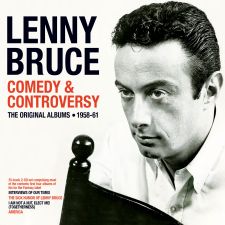 Title - Comedy & Controversy: Original Albums [1958-61]