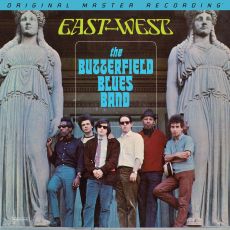
Title - East-West (180g 33RPM Mono LP)
Artist - The Butterfield Blues Band
For those unaware, The Butterfield Blues Band might be most famous for serving as the backing group for Bob Dylan’s famous electrified show at the Newport Folk Festival, but the collective earned a spot in the Rock and Roll Hall of Fame due to East-West.
Though it remains a footnote in many historical narratives, the 1966 record changed the shape of popular music, sowed the seeds for acid-rock, and further demonstrated the visionary abilities and virtuosic skills of a sextet that took the blues in novel directions.
Sourced from the original analog master tapes, pressed at Fidelity Record Pressing, and housed in a Stoughton jacket, Mobile Fidelity’s numbered-edition 180g 33RPM LP presents East-West in definitive sound — and in the original mono mix for the first time in nearly 60 years.
East-West was pressed in mono from 1966 to 1968, after which the stereo version (a revised copy of the mono original) became the only option. Featuring quiet surfaces and black backgrounds that expose critical details, dynamics, and tones, this collectible reissue exhibits elevated levels of directness, coherency, and spaciousness. You’ll experience the prized acoustics and dimensions of Chicago’s famous Chess Studios at 2120 S. Michigan Avenue, where the set was recorded.
Side One:
1. Walkin’ Blues
2. Get Out of My Life, Woman
3. I Got a Mind to Give Up Living
4. All These Blues
5. Work Song
Side Two:
6. Mary, Mary
7. Two Trains Running
8. Never Say No
9. East-West
Simply put, this is a wickedly brilliant collection of blues-rock songs that is also one of the early pillars of jam band music. East-West is chock full of great guitar playing with the searing slide of Mike Bloomfield dueling it out with Elvin Bishop’s rhythm play. The real standouts for me were the long-form jams Work Song and the title track but the opening rendition of an electric take on Robert Johnson’s Walkin’ Blues - which some of you may know from later era Grateful Dead setlists - has always been a special musical treat for me to hear, as was I Got a Mind to Give Up Living; which has tons of smooth Bloomfield licks.
The title cut is a long jam that was innovative for its time, and the exploratory jamming of this group during concerts at the time had a very big and direct impact on the musicians who quickly created the legendary Bay Area rock scene, including influential acts like Country Joe, Jefferson Airplane and Quicksilver.
And the closer, well, it is impeccable from a technical perspective, maybe one of the most important works of 60’s rock for its blending of Indian Classical music and blues and thus any and all critical language can’t really do justice to its greatness. If you, perhaps, listen to it under the influence of psychoactive substances you won’t be the same afterwards, trust me on that!
In closing, it is a landmark in the history of psychedelic/post-rock and one of the major things that went down in 1965 and 1966 that quickly turned into a musical revolution that continues to generate constant innovation to this day in thousands of descendant genres. Still today, this track is wonderful to hear, a solid and pleasant jam, not amazing or revelatory beyond its historical interest, and yet an earworm of the highest order.
Playing with incredible naturalism, revealing openness, and in-the-room liveliness, Paul Butterfield and Co.’s creations unfurl here with previously unheard definition, richness, and presence. Every aspect of the album benefits from newfound balance, symmetry, and airiness. Butterfield’s strong lead vocals and signature harmonica; Elvin Bishop’s fusion of gospel, R&B, and country threads; Jerome Arnold’s in-the-pocket bass; Billy Davenport’s bossanova-derived drumming; Mark Naftalin’s illuminating piano and organ; and of course, Mike Bloomfield’s zinging electric guitar. All come across with emotion-triggering realism and responsiveness.
Carrying over most of the same personnel responsible for its stellar eponymous debut, the Butterfield Blues Band made one key change for East-West by inviting drummer Davenport into the fold. His impact on the group’s approaches proved immense. Showcasing refined, delicate, and articulate techniques, and able to underpin the songs with a jazz-driven sense of movement, Davenport allowed the band to improvise. His rhythmic shading, coloring, and control blew open the doors of possibility that other blues ensembles never knew.
Experience their impressive 1966 effort in definitive sound with Mobile Fidelity’s Numbered-Edition 180g 33RPM Mono LP which they have now made the album available in its Original Mono Mix for the first time in nearly 60 years. It was cut as a 1/4” / 15 IPS analog master to DSD 256 to analog console to lathe.
Official Purchase Link
www.mofi.com











 Title - East-West (180g 33RPM Mono LP)