Listening To Prestige
By: Tad Richards - Excelsior Editions - $24.95
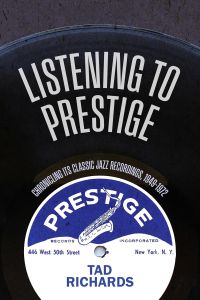
Overview: Listening to Prestige: Chronicling Its Classic Jazz Recordings, 1949–1972 is a complete chronicle of one of the greatest postwar jazz labels.
Verdict: As we descriptively discover early on, founded by jazz enthusiast Bob Weinstock, Prestige Records recorded the leading jazz artists of its day, many of whom were at or approaching their creative peak, from its inception in 1949 until 1972. It documented the changing jazz styles as they emerged, from bebop and post-bop, to third stream, hardbop, free jazz, and soul jazz, while honoring the previous generation of jazz musicians.
Prestige was also among the first labels to work with recording engineer Rudy Van Gelder, who revolutionized the way jazz was recorded. The 1950s were a growth era for jazz, as modern jazz came to be accepted as part of mainstream American music.
Furthermore, Prestige captured the leading artists of the era, including the Modern Jazz Quartet, Thelonious Monk, Sonny Rollins, John Coltrane, and especially Miles Davis, all of whom did some of their most important work for the label in this period.
As all followers and lovers of Jazz and, in this particular case, Prestige Records know, audio engineer Rudy Van Gelder was the recording engineer of oh-so many Prestige albums in the 1950s and early-to-mid-1960s. He was even behind the new labels that Prestige created in 1960: Swingville, Moodsville, covering jazz, Bluesville featuring blues revival artists, Lively Arts featuring spoken word recordings and Prestige International, Prestige Folklore, Irish and Near East with folk and world music.
This simply marvelous book itself had its genesis back ten years ago in an ongoing conversation about jazz between author Tad Richards and his friend, the painter Peter Jones, about the decade they came of age in ... the 1950s. It was a passion that set us apart from most of their contemporaries in a way that was succinctly captured by Barry Levinson’s 1982 film Diner and its character Shrevie, played by Daniel Stern.
Taking a little sidestep here to paint the picture a little more colorfully, so that you get exactly what Richards is talking about, Shrevie and Beth (Ellen Barkin) are recently married, their marriage already in trouble, because Beth has a habit of pulling a record out from his collection, playing it, and not reshelving it - or, worse yet, reshelving it in the wrong place.
Shrevie has everything arranged alphabetically and by category: jazz, pop rock and roll, folk, rhythm and blues. To Beth, it’s all just music - nice to listen to but nothing to obsess about. To make matters worse, she would never quiz him on music trivia, like the flip sides of hit 45 rpm records. They were that way, Richards and Jones. They were the guys who knew all the flip sides and they never grew out of it.
But back to Prestige, and its story starts with an 8-year-old boy, Bob Weinstock. Weinstock inherited his love of jazz from his dad, Sol, himself a shoe salesman. Indeed, Weinstock’s earliest memory is going to a flew market with his dad and coming home with a stack of jazz records they had bought for 9 cents apiece.
That was the beginning of his collecting career, and by the age of fifteen he had his own mail-order record business, advertising in trade magazines. In 1946, at the age of eighteen and with his father’s support, he opened his first record store in Times Square, near the Metropole Cafe, a midtown jazz club presenting traditional jazz artists - the music he and his father had grown up together collecting, and the music that he sold in his store. The store soon became a hangout for Metropole musicians on their break, and soon for other musicians as well. Weinstock was becoming well known in jazz circles, but he was still innocent in many ways, of course.
Pushing on through his timeline, as you yourselves can piece it together here in this dutifully crafted new prose, by the late 1950s, Weinstock ceased supervising recording sessions directly, employing Chris Albertson, Ozzie Cadena, Esmond Edwards, Don Schlitten, and producer/music supervisor Bob Porter, among others, to fulfill this function.
Musicians recording for the label in the 1960s included Jaki Byard and Booker Ervin, while Prestige remained commercially viable by recording a number of soul jazz artists like Charles Earland. In 1966 the company’s headquarters were located at 203 South Washington Avenue in Bergenfield, New Jersey.
Inclusive of chapters titled as Weinstock’s Beginnings: New Jazz, Early Artists on New Jazz, The Birth of the Prestige Label, Wardell Gray-James Moody-King Pleasure, Miles Davis, Thelonious Monk, and amongst other Enter Rudy Van Gelder and Recording More Monk and both A New Era: Soul Jazz and Moving On: Free Jazz and Eric Dolphy, Listening To Prestige by author Tad Richards shines a most glorious light on all the music created back then; especially the music that came to be known as the aforementioned free jazz, epitomized by leading Prestige artists Eric Dolphy and Booker Ervin.
Also encompassing other musicians and their respective styles, whilst dipping into other styles that came to be known as soul jazz and jazz funk, the Prestige label was, and without a shadow of a doubt, an epicenter of these sounds and here we get to hear it all take shape through the adoring words of Richards’ lifelong enthusiasm for the label and all it stood for.
To wrap the story, the company was sold to Fantasy Records in 1971, and original releases on the label formed a significant proportion of its Original Jazz Classics line. Fantasy was purchased by Concord Records in 2005 and in 2017, Concord Music Group revived the Prestige label to enable a full circle moment to finally come to be.
About the Author - Tad Richards is a prolific visual artist, poet, novelist, and nonfiction writer who has been active for over four decades. He is the author of many books, including Jazz with a Beat: Small Group Swing, 1940–1960, also published by SUNY Press. He lives in Kingston, New York.
Official Book Purchase Link
www.sunypress.edu










 Listening To Prestige