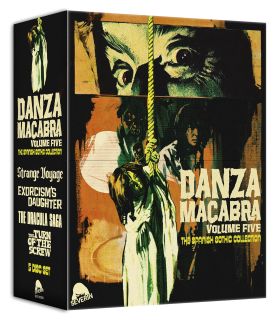
Danza Macabra Vol. Five [5-Disc Blu-Ray Box-Set]
(Carlos Larrañaga, Tota Alba, Francisco Rabal, Espartaco Santoni, Tina Sáinz, Tony Isbert, et al / 5-Disc Blu-ray / NR / 2026 / Severin Films)
Overview: For Volume Five of this “essential series of Euro-Gothic tastiness” (Mondo Digital), Severin Films returns to the cemeteries, catacombs and cobwebbed castles of Spanish cinema for an all-new exploration of Gothic Horror excellence.
In the North American Disc Premiere of 1964’s STRANGE VOYAGE, director Fernando Fernán Gómez crafts a macabre true-crime shocker featuring a poignant performance by none other than Jess Franco. The disturbing 1971 drama EXORCISM’S DAUGHTER is presented in its complete U.S. Version – now featuring the infamous orgy sequence – as well as the original Spanish Version LAS MELANCÓLICAS, both on disc for the first time ever.
THE DRACULA SAGA is 1973’s grisly reinvention of vampiric damnation from the legendary León Klimovsky, uncut in North America for the first time ever. And in 1985’s acclaimed THE TURN OF THE SCREW, controversial director Eloy de la Iglesia adapts Henry James’ classic novella with a startling psychosexual twist.
Each film in this collection has been scanned from original camera negatives or archival 35mm prints, with 10+ combined hours of new audio commentaries, video essays, interview featurettes and more.
Blu-ray Verdict: First up is STRANGE VOYAGE (1964). In 1964, renowned novelist, playwright and actor Fernando Fernán Gómez directed his most controversial film, “a truly remarkable” (Cinemagavia) gothic horror black comedy based on a shocking true crime, condemned by government censors upon its release and featuring a surprisingly poignant performance by none other than Jess Franco.
In an old dark house on the outskirts of a rural village, a matriarch cruelly bullies her two childlike adult siblings. But when dread leads to murder, will repression and deceit bring about the most depraved acts of all? Carlos Larrañaga (THE PRIDE AND THE PASSION), Tota Alba (STRANGE LOVE OF THE VAMPIRES), Lina Canalejas (BLOOD HUNT) and María Luisa Ponte (EUGENIE) co-star in this “masterpiece of artistic subversion” (The Postmodern Pelican), now scanned in 2K from the original camera negative with over 2 hours of new Special Features.
Originally titled El Crimen de Mazarrón, which was suppressed by the censorship of the times, El Extraño Viaje remains a surprising element in the midst of a rather negative period of time in Spanish contemporary history, artistically speaking. The surprise lies more in its content than in any other aspects of the film per se.
However, this piece, directed by Fernando Fernán Gómez, arose from the mysterious appearance of two corpses on the beach of Mazarrón, Murcia, as mentioned by Carlos Saura in a conversation with Fernán Gómez, who anecdotically said that a film could be made out of such an occurrence. Fernán Gomez took his word for it.
So with the misleadingly mysterious title of El Extraño Viaje, filmed in quaintly-styled black and white around the then peaceable and rural towns of Loeches, Madrid and La Pola, Valencia, today localities which are anything but peaceable and rural, was born.
Two rather backward middle-aged brother and sister - nice playing here by Rafaela Aparicio completely overriding an unconvincing Jesús Franco (aka Jess Franco and about a hundred other pseudonyms, no doubt with the intention of covering up his own mediocrity, anyway - live in the unfortunate circumstance of their exceedingly rich elder sister’s care in a huge mansion house.
But when she decides she wants to sell up everything and travel the wide world - the Caribbean, Paris ooh-la-la - her younger brother and sister get overly worried.
The noir aspect of film-making is hugely present with just that touch of ironic or even sarcastic humor which converts the telling almost into the horror genre; but that in itself was not the purpose, shall we say, of the film.
Rather, the story itself and the locations, embroidered in a nostalgic black and white backcloth, is a kind of wistful sojourn - especially seen from our stance near 40 years later - which intelligently combined with almost whimsical situations and noir humor so as to underline but not hamper any other gruesome aspects.
This certainly becomes clear when they enjoy a good strong wine with plenty of body. Excruciating, to say the least, and yet nicely juxtaposed in the development. Carlos Larrañaga did not exactly impress with his performance: he seemed to lack that something which entuned with the other characters around him in the midst of the goings-on; his playing with Tota Alba lacked synthesis. However, Tota Alba was good, but Rafaela Aparicio was even better.
Along next is EXORCISM’S DAUGHTER (1971). What was deceptively marketed in North America as an EXORCIST rip-off is in fact one of Spain’s most unsettling genre films of the ‘70s.
Driven to madness by a horrific childhood trauma, a young woman (Analía Gadé of IN THE EYE OF THE HURRICANE) is committed to a brutal insane asylum from which there may be no escape.
Francisco Rabal (SORCERER, DAGON), Espartaco Santoni (THE FEAST OF SATAN) and Helga Liné (THE VAMPIRES NIGHT ORGY) co-star in this “disturbing” (Mondo Digital) gothic drama written and directed by Rafael Moreno Alba (DREAM KISS), presented in its original Spanish Version LAS MELANCÓLICAS scanned in 4K from the original camera negative plus the complete U.S. Version (also known as THE HOUSE OF INSANE WOMEN) with additional footage – including the infamous inmate orgy sequence – now sourced from an archival 35mm print, with over 2 hours of new Special Features.
After witnessing her mother die during an exorcism being performed on her, Lana (Analía Gadé) winds up in a mental hospital with various insane women. A new doctor shows up and wants to treat these women for mental issues but he gets push back from some who sees mental illness as a sign of witchcraft.
This Spanish film was released the same year as THE DEVILS and it’s easy to see why this isn’t better known. It was re-released after the success of THE EXORCIST and it was attempted to be passed off as a horror film but it really isn’t. This one is basically a drama with some horror elements thrown in, but that’s not to say it is a schlocky film for it is very far from being such.
As with THE DEVILS, this film is basically an attack on religion and those people who are against science in favor of superstition. In this case you have a doctor who believes insane people are a mental issue and not an issue of religion, devils and witchcraft. For the most part the drama plays out pretty good and there’s no question that it’s an interesting subject.
Director Rafael Moreno Alba makes a professional looking film and on a technical level it’s good considering its low budget. Sure, it moves a bit too slow at times and there are a lot of scenes where not much happens, but there are some truly memorable moments: including an orgy sequence as well as some bizarre fantasy sequences which help keep the film entertaining to the viewer!
EXORCISM’S DAUGHTER, a title given to it to cash in on THE EXORCIST even though this was made two years before, isn’t a standout, must-watch movie, no, but it IS a really great film for fans Spanish horror. And thus for that alone I highly recommend this cinematic, and much underrated film.
Then we get THE DRACULA SAGA (1973). From famed director León Klimovsky (THE NIGHT OF THE WALKING DEAD, THE PEOPLE WHO OWN THE DARK) comes the daring gothic shocker hailed as “one of the most original vampire films in Spanish horror cinema” (Cine Maldito).
When Dracula’s pregnant granddaughter (Tina Sáinz) and her upstanding husband (Tony Isbert of TRAGIC CEREMONY) arrive at the Count’s castle, it will birth a nightmare of profane seduction, ancestral damnation and inconceivable vampiric carnage.
Helga Liné (THE LORELEY’S GRASP), María Kosty (NIGHT OF THE SEAGULLS) and Narciso Ibáñez Menta (THE BEAST MUST DIE) co-star in this “bizarre Spanish gem” (Bloody Pit of Horror) co-written by Emilio Martínez Lázaro (CAKE OF BLOOD) and Juan Tébar (THE LEGEND OF BLOOD CASTLE), now scanned in 2K from the original camera negative with over 2 hours of new Special Features.
Count Dracula (Narciso Ibáñez Menta), his nieces, Irina and Xenia (Cristina Suriani & María Kosty) and new wife, Munia (Helga Liné) are excited at the thought of a new heir, to be born by his granddaughter who has been living in London away from Castle Vlad in Transylvania for some time.
Berta (Tina Sáinz) and her husband Hans (Tony Isbert) are to visit and possibly live in Castle Vlad as heirs to Vlad Tepis’ estate and castle. What Berta doesn’t realize is that her unborn son is drinking her blood from the womb, exhausting her, while Hans has become a victim at the seductive hands of Munia.
Meanwhile, the vampires strike locals as Dracula prepares for the grand day of his grandson’s arrival, with Berta suffering not only physically, but her steady fear has evolved into mental deterioration, with isolation and the loss of Hans having quite an effect.
Director León Klimovsky maintains a really strange ambiance throughout as the film builds towards the birth of a new beginning for Dracula’s family. Dracula, as portrayed here, is an old, sad, pitiful sight, while the vampire women have vitality, quite precocious and promiscuous.
Helga Liné captivates as always, just when appearing on screen, her power is just magnetic. The pale make-up for the vampire family is ghastly and their existence is equally dreary and decadent.
The film is at times wicked, playful, weird, and violent. You have an one-eyed mutant offspring often whipped by Dracula for killing people and is such an embarrassment to him that he’s locked away. A bible-quoting priest, who is ridiculed for looking at pretty girls, falls prey to Berta’s devious cousins. Liné doesn’t wait very long before seducing Hans and he’s a willing victim.
María Kosty, as Berta’s cousin, Xenia, might be recognizable to Spanish horror fans for she has starred in such fare as Jess Franco’s Exorcismo, Ossorio’s Night of the Seagulls, A Dragonfly for Each Corpse and Vengeance of the Zombies. Tina Sáinz, as Berta, pretty much remains either frightened, paranoid, or off-the-deep-end, and it’s understandable since this movie places her in a bleak situation.
While there are moments of graphic violence, such as some ax-chopping and a poor fellow’s flight down a spiral staircase, this movie wasn’t as gory as I was expecting. There’s some blood-sucking (the necking, however, mostly occurs off-screen, bloody throat wounds shown afterward). Castle Vlad is, surprising enough, rather sunny and vibrant, not gloomy or melancholy as those who live within its environment: quite a difference from the typical Gothic horror flicks which contain a castle, crypt, and nearby cemetery.
A great deal of the film is shot during the day, or as the sun rises, another difference from what we are accustomed to. We see the vampires actually out and about as the sun remains in the sky, even though we can tell it annoys/bothers them, until they eventually must return to their resting place. The film ends - and which is for me absolute cinema personified - on a darkly comic note with Dracula, all fangs, grinning fiendishly.
Lastly, we get gifted THE TURN OF THE SCREW (1985). From Eloy de la Iglesia – writer/director of such controversial classics as CANNIBAL MAN, THE GLASS CEILING, NO ONE HEARD THE SCREAM, NAVAJEROS and EL PICO – comes the startling 1985 adaptation of Henry James’ classic novella of gothic horror.
After dropping out of seminary, a spiritually conflicted young man (Pedro Mari Sánchez of CREATION OF THE DAMNED) is hired to teach a pair of wealthy orphans in their remote seaside mansion. But when he begins to believe that the estate is haunted by the ghost of the previous cruel caretaker, it will unlock an ordeal of lost innocence, forbidden desire and immoral terror.
Queta Claver (THE PRIEST) co-stars in this provocative shocker – “a thoughtful drama with shades of SALÒ” (Beyond Boundaries) – now scanned in 4K from the original camera negative with over 3 hours of new Special Features.
Eloy De la Iglesia does well in this thrilling flick correctly adapted from the Henry James story, in my humble opinion. Lead actor Pedro Mari Sanchez gives a great portrayal as the too-impressionable ex-Jesuita who left his habit surroundings; and who also believes the gardening influence on the young children was more than malevolent. In addition, Queta Claver is excellent as the housekeeper.
In this retelling, although changed within its aspects to see another side to the retelling in places, we this time have a man whose religion is Catholic, not Anglican and the setting is Euskadi. And due to that the film most certainly packs an atmospheric and colorful cinematography into its lens courtesy of Juan Gelpi.
We also get a highly evocative and appropriate musical score by Luis Iriondo, himself also playing a count in the film. It contains some most wondrous Basque songs too, which I found very alluring towards the plot lines as they unfolded.
In short, here filmmaker Eloy Iglesia gives an unexpected academic and acceptable version, abandoning his ordinary provocation and whilst his previous films were more extremely explicit and provoking, here Eloy chooses to lean into his cinematic eye in a whole new way. This is his strangest film, sure, but also his most talked about (and for good reason).
Disc 1 Special Features: STRANGE VOYAGE
Audio Commentary With Dr. Adrian Smith, Co-Author Of Norman J. Warren: Gentleman Of Terror
A Rara Avis Duo – Ángel Sala, Head Of Programming At The Sitges Film Festival, On Fernando Fernán Gómez & Jess Franco
The Multifaceted Mind Of Fernando Fernán Gómez – Filmmaker Helena de Llanos On The Work And Legacy Of Her Grandfather
Facing The Sun: STRANGE VOYAGE’s Promise Of Broken Dreams – Video Essay By Andy Marshall-Roberts, Host Of The Nasty Pasty Podcast
Trailer
Disc Specs:
Runtime: 92 mins
Audio: Spanish Mono
Subtitles: English
Region A/B/C
Aspect Ratio: 1.66:1
Disc 2 Special Features: EXORCISM’S DAUGHTER
Disc 2: Spanish Version + Special Feature
Trailer
Disc Specs:
Runtime: 111 mins
Audio: Spanish Mono
Subtitles: English
Region A/B/C
Aspect Ratio: 1.85:1
Disc 3 [U.S. Version] + Special Features: EXORCISM’S DAUGHTER
Audio Commentary With Matt Rogerson, Author Of The Vatican Versus Horror Movies And Fulci’s Inferno: Faith In The Films Of A Horror And Giallo Auteur
A Film That Stands Apart – An Appreciation By Ángel Sala, Head Of Programming At The Sitges Film Festival
Madwoman In The Attic: EXORCISM’S DAUGHTER And The Female Gothic – Video Essay By Kat Ellinger, Author Of Daughters Of Darkness
Disc Specs:
Runtime: 96 mins
Audio: English Mono
Subtitles: English SDH
Region A/B/C
Aspect Ratio: 1.85:1
Disc 4 Special Features: THE DRACULA SAGA
Audio Commentary With Rod Barnett And Troy Guinn, Film Historians/Co-Hosts Of Naschy Cast
Klimovsky’s Vampires – An Appreciation By Ángel Sala, Head Of Programming At The Sitges Film Festival
The Spanish Hammer: The Rise And Fall Of Profilmes – Interview With Profilmes Production And Sales Executive Lluís Ferrando
Inheritance As Horror: Blood, Tradition And The Gothic In THE DRACULA SAGA – Video Essay By Kat Ellinger, Author Of Daughters Of Darkness
Trailer
Disc Specs:
Runtime: 92 mins
Audio: English Mono, Spanish Mono
Subtitles: English SDH, English
Region A/B/C
Aspect Ratio: 1.66:1 (1973)
Disc 5 Special Features: THE TURN OF THE SCREW
Audio Commentary With Matt Rogerson, Author Of The Vatican Versus Horror Movies And Fulci’s Inferno: Faith In The Films Of A Horror And Giallo Auteur
Repression And Tragedy – An Appreciation By Ángel Sala, Head Of Programming At The Sitges Film Festival
One In Four Hundred – Interview With Actor Asier Hernández
The Role Of My Dreams – Interview With Actress Cristina Goyanes
Head Full Of Phantoms – Video Essay By Xavier Aldana Reyes, Author Of Spanish Gothic: National Identity, Collaboration And Cultural Adaptation
Trailer
Disc Specs:
Runtime: 118 mins
Audio: Spanish/Basque Mono
Subtitles: English
Region A/B/C
Aspect Ratio: 1.66:1
Official Purchase Link
www.severinfilms.com











 Danza Macabra Vol. Five [5-Disc Blu-Ray Box-Set]